The first time I encountered the concept of ‘co-working’ was in the 2010s.
A friend joined a group of his peers and, together, they leased a small office – not to collaborate, but to have a dedicated space to convene while working.
No meetings. No talking necessary. Just showing up and doing.
I thought it was a beautiful idea, even if I didn’t fully understand it just yet. Still, there was something about the concept that always stayed with me.
Flash forward to the arrival of LoFi Girl and her cozy, whimsical little digital world.
The watercolor cafés. The dreamy beats. The lush plant vines and fairy lights. The whole vibe pulled me in and made me want to sit, read, or finally check something off the to-do list. I didn’t feel resigned or obligated to do the task – I felt called.
Then I stumbled upon Hindz, a YouTube creator whose tea chats evolved into these chill, long-form work sessions… soulful, intentional gatherings where other people, from other places, showed up to collectively do the hard work.
I didn’t feel so alone anymore.
I hadn’t realized how much I needed that… The real aha moment was with my Favorite Human, when I was describing one of the livestreams to him.
“Well, you do tend to be more productive when there are others around. Body doubling really works for you.”
It felt like confirmation and validation all at once.
That casual conversation gave shape to something that, turns out, I’d instinctively been building into my life, long before I ever knew the term.
Doing assignments with my peers, as far back as theater school, made the heavy weight of completing a task feel much lighter. I didn’t need reminders or deadlines – just that shared theatre kid energy with a dash of focus and softness.
It really was my productivity fuel…
Some of the best things I’ve ever drawn or written were done in those hallways.
It seems my body already knew what my brain hadn’t caught up to yet: being near someone else made the hard things easier for me to carry. I didn’t have to earn or explain anything.
Just being with others was enough.
And no, I didn’t always finish what I started… but I wanted to. And that was the shift that gave me the power and the drive to do more.
As I’ve gotten older, I’ve gotten more consistent with integrating co-working into my daily routines. Sometimes it’s just a study livestream, the energy calm, but focused. Other times, it’s LoFi Girl, looping endlessly with her soft rainfall in the background and the repetition of familiar house beats.
She holds me in place and asks nothing from me.
In other instances, it’s morning coffee chats with friends. And even then? There’s no pressure to speak. Cameras off or on – it doesn’t matter. We say hello. We sip our coffee and then we get to the business of work.
No explanations and we don’t answer to one another.
We simply co-exist in a supportive space.
That kind of support is rare and hard to find.
And I think that’s what makes body doubling so powerful: the quiet accountability. There’s no pressure. No performance. No masking. Just a shared intention to start what otherwise feels too heavy to do alone.
Unfortunately, focus for me has never been linear – it moves, shifts, and often slips away. My brain just doesn’t follow the usual pathways. Focus often feels a bit like a moving target and it never quite arrives when – or how – I expect it to.
I sit down to do one thing and end up twenty tabs deep, researching something wildly unrelated but incredibly interesting. And yeah, sometimes it is productive.
But it’s not the thing I meant to be doing.
And I know that.
That knowing gets heavy.
Music helps, but only if it’s the right genre – ambient, chill house, binaural beats. Anything else pulls me too far out of the moment. One wrong verse and suddenly I’m spiraling through a memory I wasn’t planning on revisiting or a conversation I should’ve had, maybe five years ago…
It’s exhausting.
But again, that’s why body doubling is so effective – it doesn’t ‘fix’ anything, but it interrupts the drift and grounds me just enough to do the work and keep my brain focused.
I don’t think I would describe it as motivation or discipline, either.
It’s something altogether different and lighter, more like a tether. And here I am, floating out in the world, but someone else is holding the other end of the line.
I also never expected it to change my sense of self, so drastically. I stopped seeing tasks and projects as mountains and stopped blaming myself for not being able to climb them as fast or as high as ‘everyone else’.
Not because I was suddenly better at productivity or because inspiration struck, but because I wasn’t by myself. Suddenly, the tiniest things, the ones that used to get buried beneath layers of overwhelm, started getting done:
I answered that email.
I read those thirty pages.
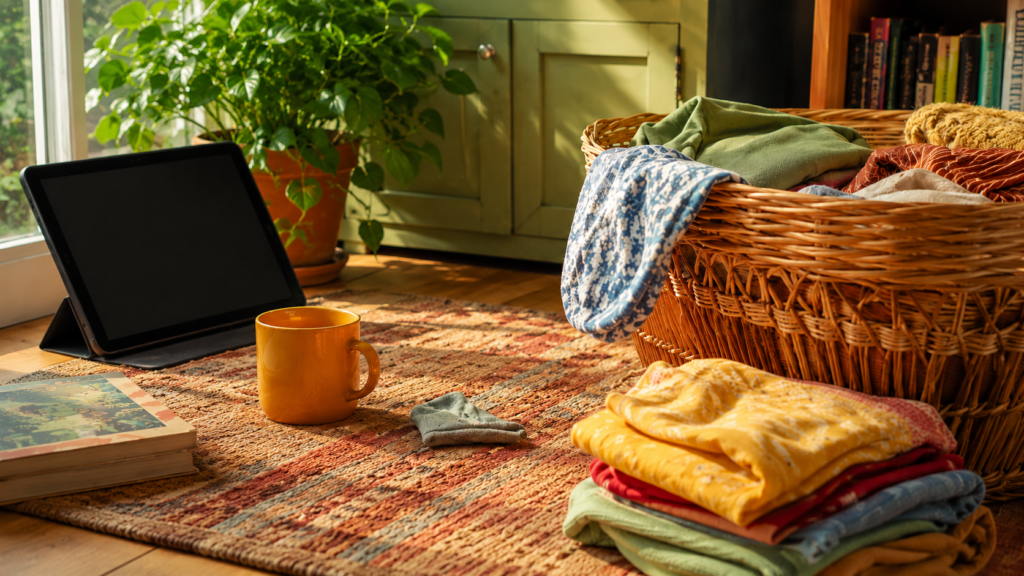
I finished the laundry I’d been ignoring and put it away.
All small things, but they add up to a shorter to-do list and a clearer mind.
And don’t think people talk about that part enough: the relief.
Not from finishing the task, but from no longer carrying the weight of the undone. I used to think productivity had to look a certain way – tracking my time with a perfectly filled-in calendar, every item checked off, on time, every time.
Yeah, sometimes I still chase that.
But I’m learning to make space for a different rhythm… one where progress doesn’t always look like completion and showing up matters just as much – or maybe more – than finishing.
It’s a softer kind of accountability that fits how my brain moves.
All I know is that it helped me stop feeling less than and start feeling more able and the proof of that, so to speak, is in the productivity pudding.