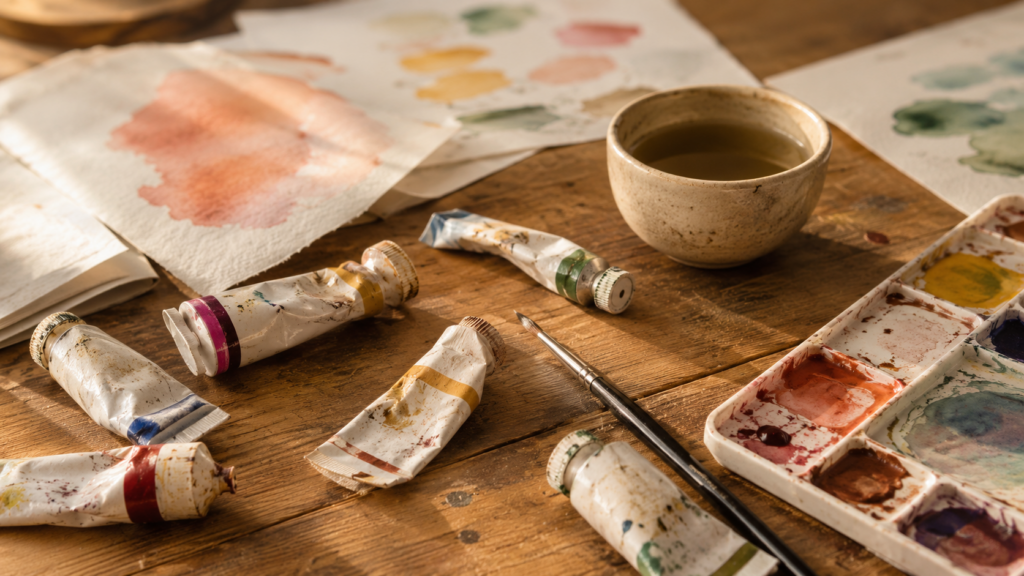
Watercolor has a mind of its own.
Unlike oil or acrylic paint, which can be controlled and refined with precision, watercolor moves freely – blending, bleeding and creating shapes that will often surprise you.
This unpredictability is both its greatest challenge, and its most beautiful quality.
For years, I put my artistic side on hold and when I finally picked up a brush again, I struggled to find a medium I could connect with.
I tried working with acrylic again, convinced that mastery would come with time, but no matter how much I practiced, something always felt off. The colors lacked vibrancy, depth was never quite there, and my pieces felt flat – lifeless, even.
I’d see the image so clearly in my mind, but putting it on canvas was disappointing.
Watercolor was different.
The first time I dipped my brush into water and watched the tint bloom across the page, I knew I’d found something special. It wasn’t just paint sitting on paper, there was movement in the pigment that made it felt alive.
With a couple of brushes and a small palette of colors, I began experimenting, but it didn’t take long to realize I needed guidance.
Eventually, I signed up for a local watercolor class taught by a talented local artist and instructor. There, she taught me the fundamentals and, more importantly, to embrace the medium’s unpredictability.

At first, I really fought hard against the nature of it.
The perfectionist in me wanted control over every brushstroke, to force the paint to behave in a certain way. But watercolor is fickle and fighting it only led to frustration.
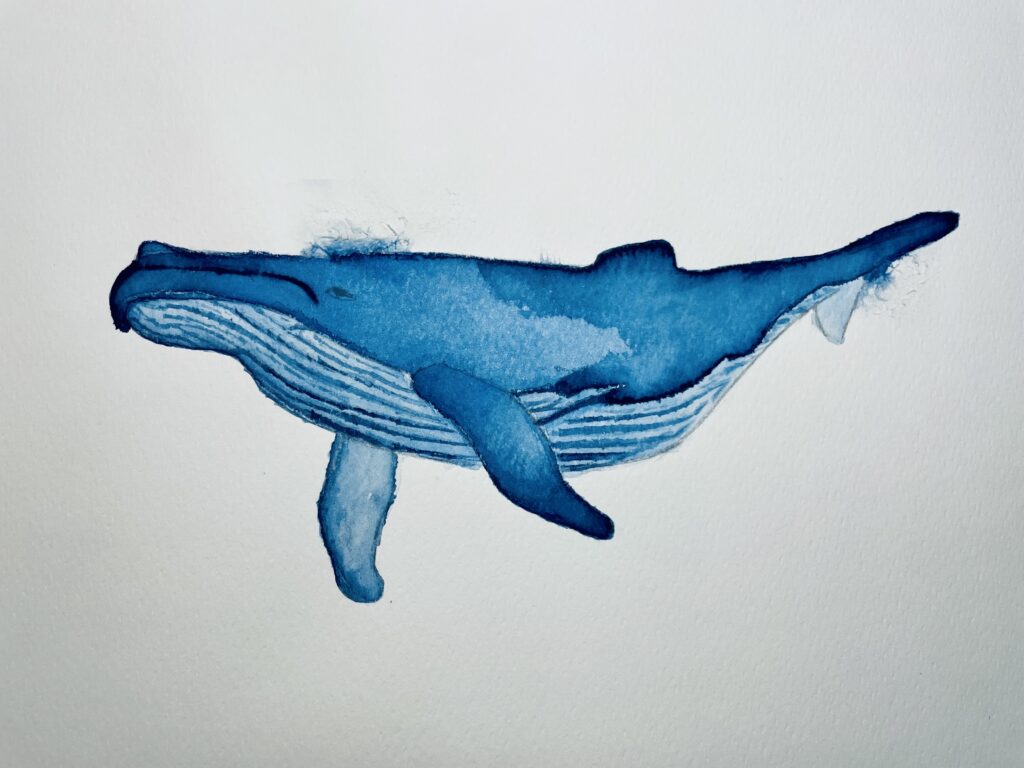
One of my most unforgettable lessons came while doing a study on whales…
Determined to improve my layering technique, I carefully built up a form, but in my eagerness, I overworked the paper. Some areas became muddled and others tore slightly.
Then a stray drop of water bled into the composition.
Frustrated, I set the painting aside, convinced that I’d ruined it, but when I returned to it a few days later, I saw it quite differently.
The unexpected bleeds and blown edges gave the painting a sense of motion, qualities that, in hindsight, perfectly suited the subject.
What I’d considered mistakes had, in fact, made the piece more dynamic.
That experience shifted my perspective – not just on watercolor, but on my creativity as a whole and I finally realized that control wasn’t the key to an accomplished piece, vulnerability was.
My biggest challenge in watercolor, however, is mastering patience.
The waiting, the pausing, the knowing when to stop… Unlike other mediums, where mistakes can be corrected, watercolor demands restraint. Once the water flows, it takes on a life of its own.
I’m still learning to resist the urge to fix things immediately or add just a touch more color, to trust that a drying wash might settle into something unexpectedly beautiful or to recognize when I’m overworking a piece.
Color has been its own lesson entirely.
And don’t get me started on granulation!
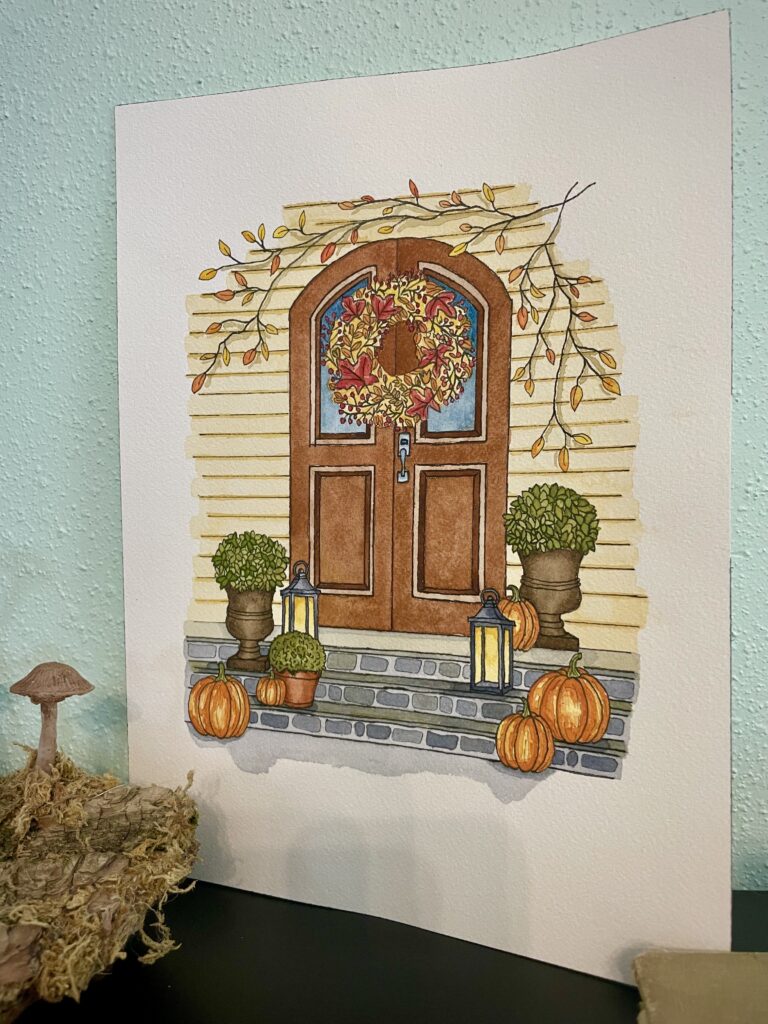
Recently, I found some motivation and a great template and attempted my first architectural piece since college.
The process of creating perspective with paint felt overwhelming, initially, but I loved the challenge. It took me back to technical theater, when I used to design and draft light plots and scenic designs.
And that felt really good.
Unlike freeform or portraiture, which feels intimidating, perspective drawing has always felt comfortable. There’s a logic to it – a set of rules that guide my eye and help me build a world on paper.
It’s deeply satisfying to see how a few well-placed vanishing points can transform a flat surface into something dimensional.
So, bringing watercolor into this structured approach felt like the perfect fusion of discipline and fluidity. The inked lines provide the framework, while the watercolor breathes life into it and I’m excited to experiment more with this style.
Though they seem like opposing forces, structure and spontaneity complement each other very well, and it’s in that spontaneity, I believe, that an artist is able to really find themselves.
My watercolor practice isn’t fully rooted in intuition, just yet.
I still overthink when painting but as my foundation grows stronger, I find that I don’t need to force the process as much. And, to date, there’s only one time where this balance of structure and surrender came together perfectly.
Unlike architectural paintings, where the piece is carefully mapped out, this was the complete opposite: painted in the moment with no real plan in place.
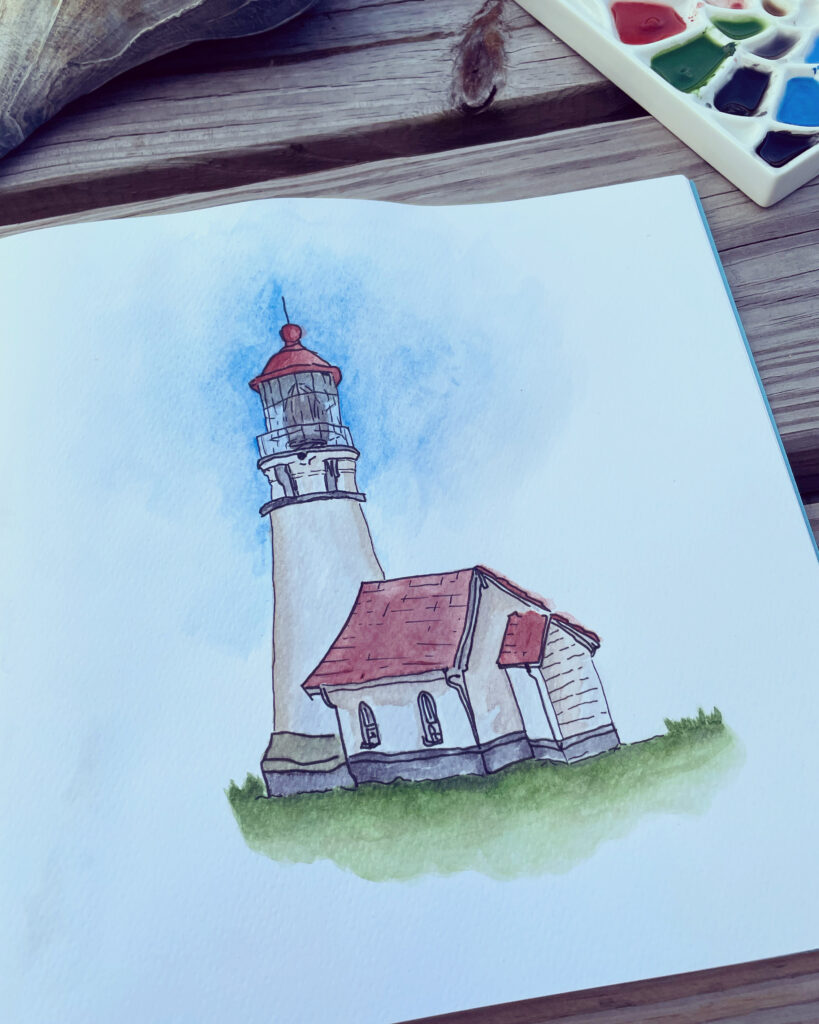
The lighthouse came to be after a stunning day on the beach in North Carolina.
As the sun was starting to set, I grabbed my supplies and headed to the deck for some creative time. While we were swimming earlier in the day, I’d captured a bit of ocean water for painting with and I was excited to see what I could do with it.
It was the best piece I’ve ever done.
Not for technique, but because it was created in collaboration with nature.
What I felt that evening was profound, to say the least.
It was one of those rare moments when creation felt less like effort and more like communion with something greater. The sound of the waves, the salty breeze, and the fading warmth of the sun all became part of the process.
Though I’ve come a long way, I’m still evolving.
My style is still taking shape and each piece teaches me something new, whether it’s about technique, perspective, or seeing the familiar in a different light.
Watercolor teaches me to embrace the unknown.
Be vulnerable.
It shows me mistakes are just new possibilities in disguise and that letting go doesn’t mean losing control.