I wasn’t expecting a simple quote to stop me in my tracks, but it did.
“Colonialism didn’t just steal land – it rewrote the story of nature. It taught us to see the Earth as something to dominate, not something to belong to. The fight for decolonization is the fight to unlearn this lie and rebuild our relationship with the planet.”
I read it again. And again.
It wasn’t that I didn’t have that awareness…
I’ve long felt a sense of belonging to my gardens, not the other way around, because I don’t view land as something a person can own, at least not in any real way. But seeing it written out like that – so precise, so sharp – made it difficult to sit with.
It confronted me with something I already knew, but rarely examined head-on.
My ancestors took land that wasn’t theirs.
This isn’t some vague historical wound… it’s direct, traceable. And yet, they were also stewards, in their own way.
My Granddaddy spent most of his life timbering land around the Roanoke River, working to ensure what he harvested was replanted and maintained. And my Dad attended North Carolina State University for forestry, attempting to carry on that same tradition of land conservation.
Further back, I come from a long line of farmers and land laborers… Many of my ancestors lived close to the land, growing, tending, and sustaining.
But now, I find myself questioning what I was told.
Were we truly guardians or were we just careful masters?
Did our care for the land come from a place of relationship or from a sense of ownership? Did we preserve the land because we belonged to it or because we wanted it to continue belonging to us?
Because sustainability is not the same as reverence.
And conservation is not the same as belonging.
Living on the land and belonging to it are two different ways of being. There’s a very distinct difference between working with nature and believing that you have the right to manage it.
And somewhere in that space between taking and tending, guilt and love, is where I find myself tangled. This isn’t just personal, though… It’s buried in my DNA, the idea that land is something to be owned, divided, and controlled.
It runs so deep that it’s hard to see it as a construct at all.
But not everyone sees land this way.
For the Wahpékhute peoples, on whose lands I live now, land was never a possession. It was, and is, a relative… Someone to be in relationship with, not something to control.
The land sustains, and in return, it is cared for, honored, understood.
I’ve lived in Minnesota for twenty years… I’ve walked her land, planted in her soil, felt the shift of her seasons in my bones.
But I will never know her in the same way the Wahpékhute do.
Mitákuye Oyás’iŋ. We are all related.
Not as a metaphor or a pleasant philosophy, but as a lived reality. The rivers, forests, and prairie aren’t resources or commodities to be managed, they are our family.
And yet, the very land I stand on – the soil beneath my feet – was stolen.
Not just through violence, but through the slow, grinding weight of treaties that were never honored, forced removals, and the relentless carving up of land into property.
This place, once woven into a vast and intricate system of care, was reshaped into something foreign: acreage, lots, taxable parcels of real estate.
The unavoidable truth is my family cared for the land, but they also controlled it. They honored it, but they also owned it. They planted trees, but they also decided which ones were worth keeping.
That way of thinking shaped me, whether I wanted it to or not. Even as I work to see differently, that framework is still there, and it’s something I will have to unlearn, piece by piece.
Because I don’t know how to untangle that, I don’t know where the line is between tending and taking, reverence and rule, love and possession.
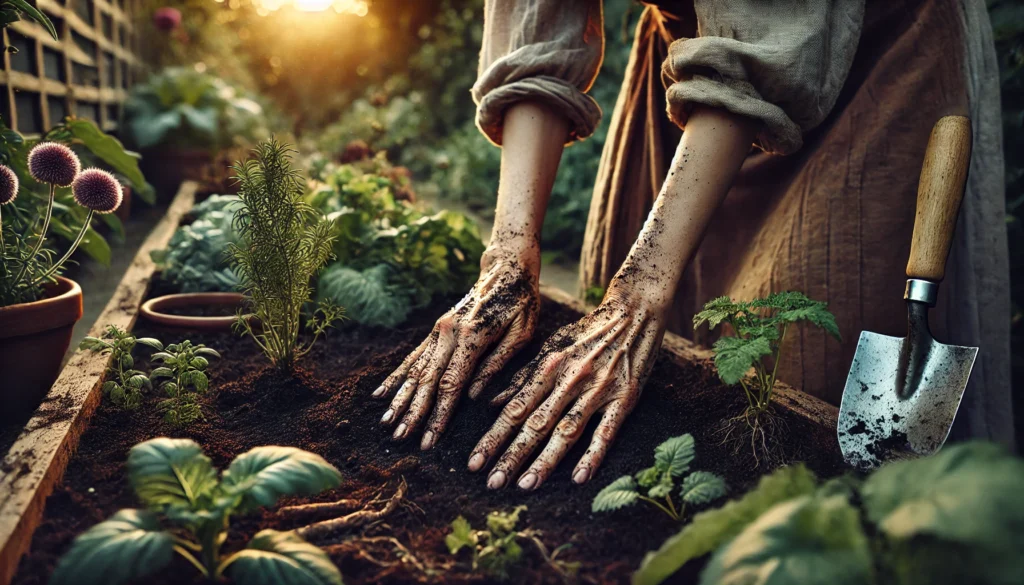
It isn’t a simple contradiction… It’s a fracture that runs through my lineage, through the land, and through me. I feel it in my hands when I press them into the dirt and I don’t know how to process that.
It’s complicated to feel deep ties with a belief system I did not inherit, and yet, in so many ways, it feels like a truth I was always meant to return to.
I remember walking through the woods with my Granddaddy when I was little, the way he would point out different trees, name them like old friends.
Loblolly Pine. Sweetgum. Beech.
He would tell me which ones were good for timber, which ones grew fast and which ones held the soil together near the water.
I loved those walks.
There was certainty in the way he spoke, as if the land was something that could be understood if I just listened hard enough. But there was always a lingering feeling I didn’t have words for, then.
Something about the way he described the land in terms of use – as lumber, as a resource, as something to be planned for.
There was love in his voice, but there was also control.
When he spoke about the land, it was always practical, measured: how many years before this stand would be ready for timber, which trees needed thinning, which patches of underbrush were too thick for new growth.
I don’t think he ever saw himself as taking, though. To him, timbering was part of the cycle. You planted, you harvested, you replanted – that was the order of things.
But if the land could speak, would it say it was cared for or simply used?
For so long, I’ve thought the best way to honor what I had inherited was to continue it – to plant, to tend, to conserve. And I don’t think growth means rejecting what I’ve learned, but it does mean I need to reshape it.
Because when I teach my own child about the land, I don’t want to pass down a tradition of ownership, I want to pass down a tradition of listening.
I don’t have an answer for any of this, and I don’t know if there is one.
I just live with the tension of it – the knowing, the not-knowing, the inheritance of harm and the inheritance of care.
The past is tangled up in my hands every time I touch the soil.
While I cannot change what came before me, I can decide how to move forward, and often I find that unlearning starts with surrender.