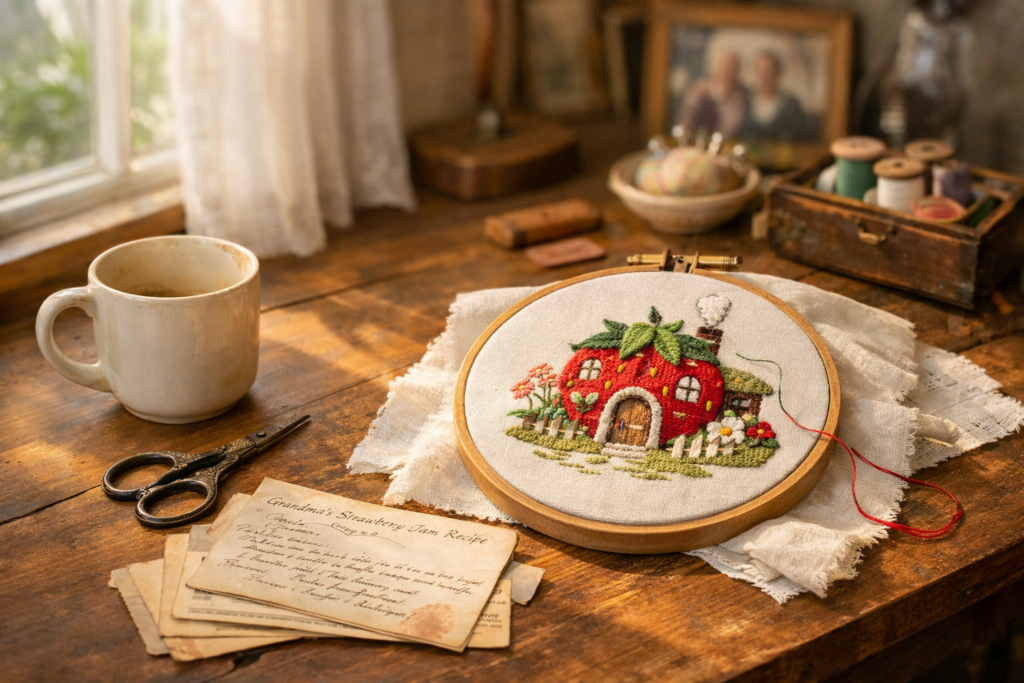
I was sitting at my desk, some mornings ago, bright light coming through the windows, coffee poured, trying to get a little stitching done before the day picked up speed.
I’ve been working on a piece for the kitchen, trying to further emulate the window from my paternal grandparents’ kitchen, or maybe not even the window itself so much as the feeling of it.
Their windowsill was full of recipe boxes, knickknacks, and little stitched pieces. It was warm and cozy and the kind of ordinary family space that only becomes sacred after it’s gone.
The fan was on, for white noise, and I had a livestream playing in the background that I was half listening to, half not. And I was just sitting there with the piece in my hands, thinking about their kitchen, thinking about this house, thinking about how much work we’ve put into making this place feel like a home that could hold people for generations.
A family home. The kind that lasts.
And then it hit me.
There is no one after my child.
Homes and heirlooms are supposed to pass from hand to hand, each generation adding their own layer without breaking the thread, but after them?
There’s no one left.
That fear came over me so fast it almost felt physical.
All four of my grandparents are gone. My parents are gone and I have no siblings. My dad’s brother is gone too, and he never married or had children. I was the only grandchild on that side.
My mom’s side branches somewhere else now, somewhere I no longer belong.
I’m married and have a child of my own, and they’ve been very clear that they don’t want children. And I’m not angry at them for that.
Not even a little.
I love my kiddo exactly as they are. Their life is their own, their body is their own, and I would never want them to have children out of obligation, or guilt, or because they felt cornered into fulfilling some story that someone else wrote for them before they were even born.
A child needs to be wanted fully, freely, and without resentment lurking beneath the surface.
But that isn’t the part I’m struggling with.
What I’m struggling with is a quieter, older ache. One that whispers underneath the practical conversations, the modern language, and the acceptance.
The ache that asks, “If there is no one after us, then what happens to all of this?”
What happens to the furniture, the blankets, the recipes, the artwork? What will happen to all the small saved things that only mean something because someone loved them long enough to keep them?
Do our things get scattered into thrift stores and estate sales, separated from the stories that made them matter? Will some stranger pick up a watercolor or a recipe box or a framed piece of embroidery and think it’s charming, yet never appreciate how much love and intention went into it?
What happens to our home?
Who will remember us?
We built so much of this place as a love letter to our history. Not in some formal, museum-like way, but in the real life way… the fixing and saving kind of way. We’re teaching our kiddo how to sew, garden, repair, and make meals that’ve been made for nearly four generations.
This house isn’t just where we live.
It’s the only family home we have left.
All the others are gone.
Some were lost in death, some in distance, some in courtrooms. So many personal possessions that existed once on walls or in drawers and rooms now exist nowhere I can reach.
Maybe that’s part of why this thought caught in my throat so hard, because I know what it is to lose the physical evidence that people were here.
I know what it is to watch a life get broken apart into piles, decisions, and silence.
Do we really just vanish?
I think that’s the fear, if I’m honest.
Not the death itself, exactly, but the oblivion. The fear of not being remembered.
All this has helped me understand my Granddaddy in a way I never imagined I would. I thought I understood why the line mattered so much to him, but I only understood it in theory. It feels different now that I can feel some of that fear in myself.
I have some understanding now of why he wanted the line to continue so badly.
I have empathy for that deep, genetic desire for there to be someone after you who carries the name, the stories, the blood, the proof that you were here.
I understand it now, and I hate that I do.
Because it feels, in some dark and irrational place, like failure.
Not because of my child. Never because of my child.
But because I can feel the centuries of expectation sitting behind me. The old script that says the line must continue, the house must continue, the name must continue, and if it doesn’t, then somewhere along the way we lost what should have been kept alive.
I know logically that’s not the whole truth. I know love is bigger than lineage and family is bigger than inheritance. I know a life is not a failure because it does not replicate itself.
But some feelings don’t care how enlightened you are.
Some feelings arrive from a much more liminal place.
I’m realizing that I may be near the end of something, and that I finally have some understanding of why that would have terrified him.
Because I don’t know what happens to an ancestral line when it stops.
But I do know what it feels like to be left here, trying to hold it.
Leave a Reply